The subway is a world of its own. no matter if you are a native New yorker- as soon as you walk down the steps onto the subway platform- it seems like a new country- full of unique social norms, rules, and conduct. In this blog, I will be posting my observations of the behavior in the subway.Feel free to make any comments or pose any questions...

a unique perspective

a unique perspective
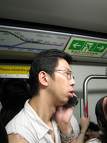
Looking into a window from underground

Tuesday, September 19, 2006

Mom said not to look into anyone's eyes and I'll be fine.


Subway Behavior


When you hear the term "subway behavior", you might be thinking of all the exciting music and special performances in the hubs as shown below in the video found on youtube.


However, the true behavior is inside the train. There are subtleties about the way the passengers on the train interact that conflict with normal social norms, traditions, and customs of the subway.In a way, the subway system is an underground society.


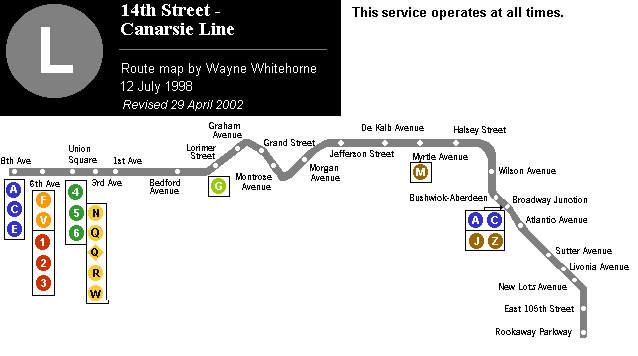
Through my travels on the subway Canarsie L line I found that there were certain customs of the subway and actions that people do without realizing. I've listed them accordingly with its context and a brief interpretation:


Looking in the windows as a mirror: I saw three people that continuously looked at themselves in the window as if it were a mirror. In it they fixed their eyebrows, hair, brushed off lint from their clothing and one of them smirked. It seems like in the subway, people need to prepare for the outside world again by making sure they look good or their hair is straight. Perhaps it is because they have an interview to go to or just caught the train and want to organize themselves, but I feel like there is something more- it says that in NY-everyone is always watching everyone-as long as they don't look you square in the eye.


    Cell phones: Now, usually when you go down several feet underground, you do not get any service. However, several people were just looking at their phones checking the time and one was even playing a game. This need to constantly do something rather than sit back and relax tells us something very important about NY. Everyone seems very wound up. Also, out of boredom, I've noticed that people still try calling even when they know they will not get service because for some reason- they need outside contact- could this be how people escape claustrophobia in the subway and deal with the "buried alive"fear?

    Seating: There are a few procedures about seating.


  1. Even after you have waited a clear thirty minutes for a seat, if a pregnant woman steps into the train she automatically gets the seat- this is interesting because it is a common courtesy that remains part of the real world.


  2. Everyone strives to get a seat during rush hour, but when it is not, people will sit themselves one seat apart if they can. Changing seats and distancing is a way of keeping to yourself. People also tend to do this during rush hour especially if they are sitting next to someone that is outside their scope of "normal". Is there a fear of catching cooties? I think not.


  3. Race is a seating factor. I've noticed that there is a clear racial determinant in how people arrange themselves in a subway car. Someone white will most likely, perhaps unconsciously, sit themselves next to a person of the same color and then choose according to what social / economical class.

How we make contact: I've noticed, and have done it myself- starting up particularly interesting conversations wityhh strangers. Whether its asking for the time, trying to get directions, or noticing something in common-people try to foster connection. Perhaps because NY society has made us disconnected- one might claim that the subway gave Manhattan its community feeling- but one might point out that in some ways- it has isolated us further.

While this is only scrapes at the surface of the different behavior found beneath the city, it does account for some very important ones. I would say that there is a feeling of distrust, disgust, and dismay in the subway. I would say that people need something to remind them that there is an outside world and barely does anyone want to interact with people on the subway. There are innocent gestures that we do unconsciously because, in a way, we want to interact on the subway. It is our actions and new behaviors underground that tell so much of how the people of this city are and act in awkward social situations.

Sunday, September 17, 2006

Johnny Cash says "walk the line"- I say- take the "L"

The Canarsie Line begins at Eighth ave and 14th street in Manhattan to Rockaway Parkaway in Canarsie, Brooklyn. At this time, it is a two-track subway from its Manhattan to Broadway Junction in the East New Yorksection of Brooklyn, but there is a short distance at the wilson Avenue stop where it is a double-decked structure with the southbound track outdoors directly above the underground northbound track. The line then goes on ground-level for mosto f the track ending at Rockaway Parkway. When you reach the end of the station you will see a network of gates that cleverly work to keep paying customers happy as they get to transfer to a local bus with no additional cost. However, be careful, otherwise you will go through the wrong gate entry and exit the station entirely. You will not be allowed back in without paying the fare.
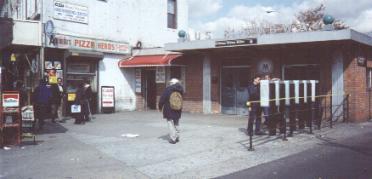
The buses to transfer to are B42, B82, and just a block away B17. There are fast food restaurants, local pizzerias (including the oldest one in Canarsie still operating since the late sixties), a church, several clothing stores sporting kids, women's and men's garments.


Above: This is the front of the station and right next to it-as stated-is the oldest pizzeria in Canarsie- Armando's. Although I wouldn't call them the best I've ever had- I would say that it is still very good and still gives some of the older residents who have lived here for so long-
A piece of what they know as childhood.

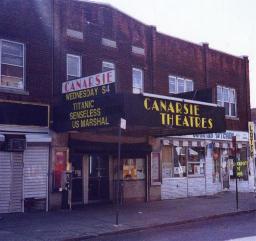
You used to be able to take the B17 from the rockaway parkaway station to Avenue L to go see a movie at the Canarsie Theatre. However, due to theft, other c rime, and lack of business, this theatre closed down some years ago. (old favorite place to go of mine)


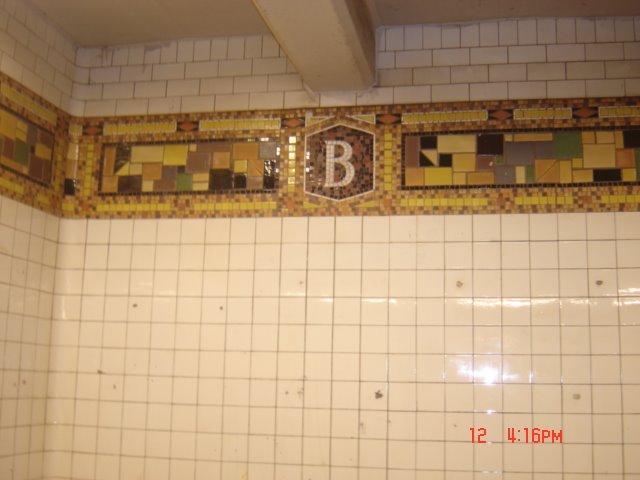
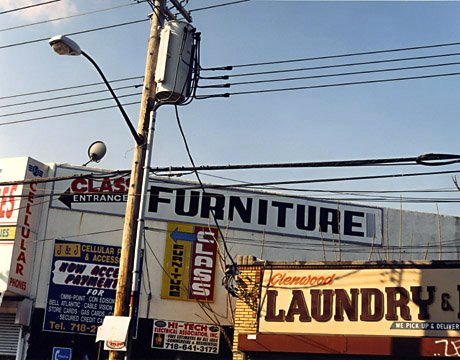
As you start out from Manhattan the train will br very crowded and very diverse, as usual. However, it is somehow cleaner, more lively-with music playing and sometimes a good talent show at Union Square. However, as you move down the line, you will notice that the people riding have something to them that is particular. An obvious observation as you ride is that most of the passengers are African-american. While you will see very energetic children, you will also have very tired and dreary company that just want to get home- as anyone would like to during rush hour. But it is a different kind of tired- it is exhaustion from working hard for just putting a safe roof over their head and food to eat- Brooklyn may have cheaper rents but it is still part of NYC and that means expense-especially if they work in Manhattan and need to commute. You will see that they do not wear the expensive or trendy clothes you might see people wearing from the Canarsie line start near 8th Avenue or Union Sq. The line goes through poor Brooklyn neighborhoods that seem dangerous. Before the Brooklyn-Aberdeen Station is Wilson Avenue- outside you will see a cemetary between the two underground spots and in Wilson you will see very colorful tiles that try to make the place enjoyable.
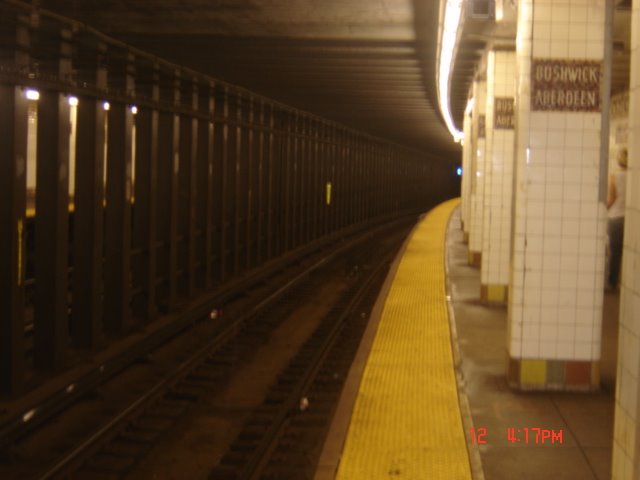
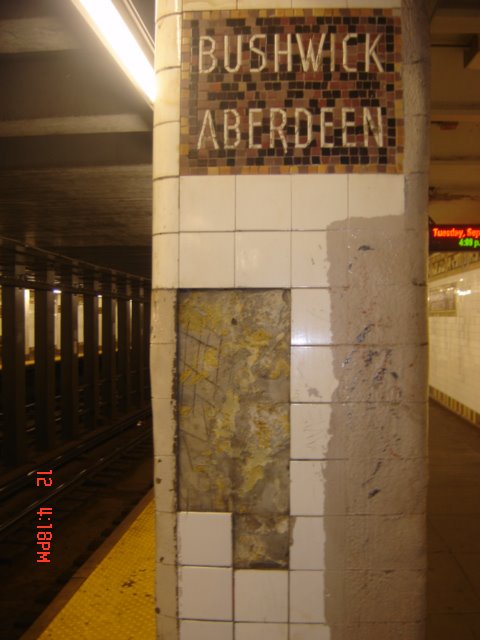
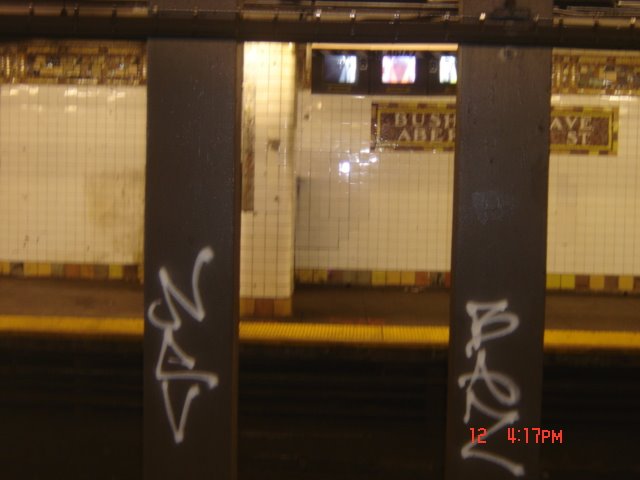
Overall, Canarsie and the other neighborhoods surrounding this particular BMT line were once considered suburbs of Brooklyn but now could be judged as scummy or ghetto-like. A place of fear and despair- a place that needs saving- but perhaps it is just a place that has been turned this way due to negligence and corporate develpment?????!!!!

To be fair, there are renewal projects going on all over Brooklyn- greenstreets, community schools, and other outreach programs are truly trying to educate today's youth in these areas and are trying to revive the wonderful spirit that was once Canarsie and the other neighborhoods.

Tuesday, September 12, 2006

The Train


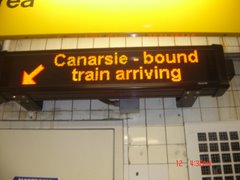
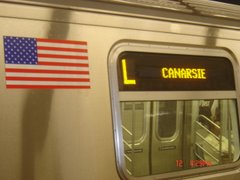
Up until recently, the subway cars on the Canarsie L line were old and deteriorating. But then, the whole line was replaced with brand new trains that contained aides that helped visual- and audio- impaired people know where they were headed and when they would arrive without having to rely on the kindness of strangers. With these new, faster, and cleaner trains, tourists have found an easier way to get around without getting lost.

The Many views of Aberdeen.

First Impressions
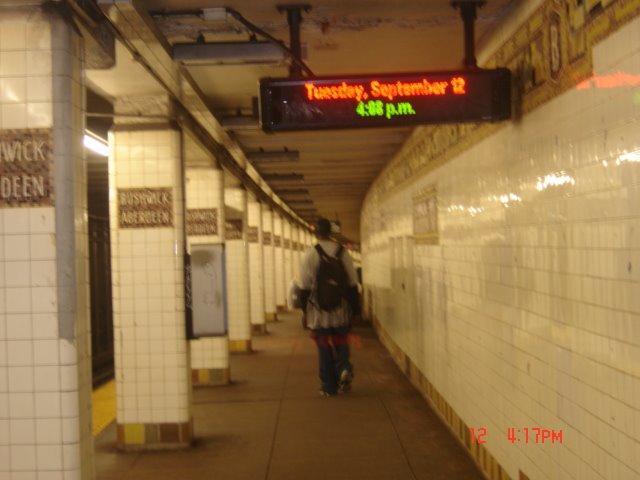
Once you arrive at the Bushwick-Aberdeen Station, you seem to be in a different world than when you stepped on in Manhattan. It is quiet and desert-like with the warm sticky air floating about you. As you wait, you notice the stained, un-maintained walls of the building. Although, you see tinged and jaundiced looking subway tiles , you can almost picture a brand new, beautifully decorated station back when it opened on December 14, 1928. However unsanitary it is, as most stations are, it is much better than in the past and one can see that is improving. The fact that it "is" quiet- says something in itself.

Old Bushwick- The stereotype of a dangerous neighborhood that turns people away-even today.

“After World War II, African Americans and Puerto Rican immigrants, who were poorer and had a lower social class than the arostocratic whites, began to move into Bushwick. Small apartment buildings were also built to accommodate the incoming residents. The change. At the same time, locally rising energy costs, advances in transportation, and the invention of the steel can encouraged beer companies to move out of the New York City area. As the breweries all closed, the neighboorhood deteriorated along with much of Brooklyn and New York City. Discussions of urban renewal took place in the 1960s, but never materialized. In 1960 Bushwick was 70 percent white, by 1977 it was over 70 percent Black and Puerto Rican (Goodman 180). One out of every eight buildings were damaged or destroyed by fire every year fom 1969 to 1977 (Goodman 122).”


The Expected Dangers

In 1977, there was a major blackout that disabled New York City. There was Arson, looting, and vandalism that resulted in many poor neighborhoods-Bushwick was one of the most severly devastated areas. Many shops were looted and burned down. Those who profited from theft, saw this as an opportunity to get what they couldn’t afford. It is because of incidents like these that made Bushwick, even to this day, a seemingly undesireable place to live


New Bushwick

Towards the millenium, there started to be less crime citywide and there started to be a shortage in other stylish and attractive neighborhoods like Greenpoint and williamsburg. There was a surge of white people that moved into converted warehouse lofts, brownstones and other buildings. While it was slightly less safe than the other neighborhoods, Bushwick property values started to rise and people noticed gentrification starting. This is a “process in which low-cost, physically deteriorated neighborhoods experience physical renovation and an increase in property values, along with an influx of wealthier residents who displace the neighborhood's original inhabitants.” (wikipedia)
The results of gentrification are a source of academic and political controversy. It can be a great advantage for homeowners and can boost local tax property revenue, which improves services for all residents. “This, along with the related boost to the local economy, can improve crime rates, reduce unemployment, and clean up blighted regions. Resulting rent increases and reduced supply of low-cost rental housing can displace lower-income and working class residents—often including members of minority groups. The extent of this displacement is often disputed, as is the offset of benefits like new jobs and expanded public services.” (Wikipedia)


This is Bushwick Avenue–Aberdeen Street. "It has an interesting design. The entrance to this underground station is in a small building on the north side of Bushwick Avenue between Aberdeen Street and DeSales Place. In this space are 11-foot high coffered ceilings, suspended light fixtures, and fancy ironwork. Parchment brown replacement tiles can be observed. The platforms are slightly curved to the right, and the two tracks are at different levels at the north end of the station, with the southbound tracks being higher due to their descent from an elevated stretch at Wilson Avenue. The pillars are covered in white tile, with mosaics on each one bearing the station's name, "Bushwick Aberdeen". The elaborate porcelain mosaic band is predominantly tan, peach, mauve and brown with yellow, cream, green, rosy beige, slate blue, indigo and black grape tiles in the center. In the mezzanine, there are also bright aqua tiles, as well as the above-mentioned brown replacements." (Wikipedia)

The reason why I chose this station is that I grew up using the L line in Canarsie and wanted to explore the rich history of something my family and I used every day. The station itself I am not familiar with- and while it seemed deserted- my observations of the behavior of the people on the train seemed interesting. Please see the next entry for my observations and enjoy the history of what is Bushwick.

About Me

My photo
I am a person with a cheerful and optimistic disposition but still cynical and slightly morbid. I am all about honesty, practicality, and efficiency. Where do babies come from? A stork? i think not. Tell the kidlets the truth instead of scarring them for life and costing them thousands of dollars in therapy when they're 40. although it'll probably happen anyway. I am also the person who thinks about what others don't. Like life insurance.

Blog Archive

"Chance:Pay owner twice what he is owed"

"Chance:Pay owner twice what he is owed"
Take a ride.